Parish & diocesan management · Made in Ireland

One system for every parish in the diocese.

Emily Helps runs the parish office — census, collections, sacraments, the Charitable Donation Scheme — and gives the diocese a live, consistent picture across all of its parishes. Hosted in the EU and built around how Irish parishes actually work.

In daily use in parishes of the Diocese of Waterford & Lismore

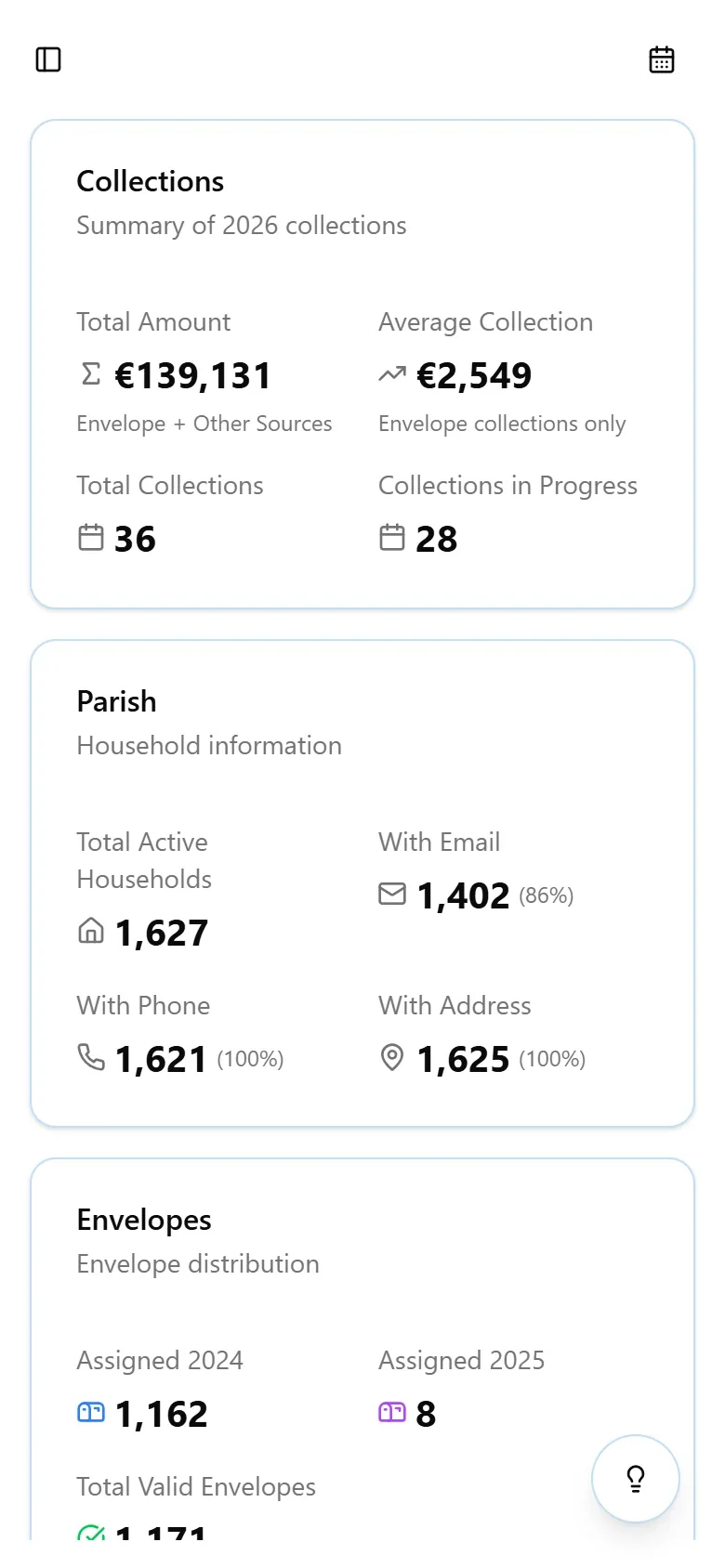
The Emily Helps parish dashboard: collections summary, household counts, envelope distribution and the list of upcoming sacraments

What a diocese gets

One record per parishioner, shared properly

Households, sacraments and contributions are linked to the same person, in the parish that holds them. Each parish keeps its own data; the diocese sees the whole picture without seeing what it shouldn't.

Registers that stay in step

When a confirmation or marriage is recorded, the baptismal parish is notified so its register can be updated — no letters, no chasing, no gaps between parishes.

A diocesan website that never goes stale

Parishes, churches, clergy and Mass times are published to the diocesan website from the same data the office already maintains. Change it once; it's correct everywhere.

What's inside

The whole parish office, in one place.

Everything below is real and in use today — these are screens from a parish running on Emily Helps, with demonstration data.

Census & households

Every household, every parishioner, one clean list.

Names, addresses, envelope numbers, phone and email, and who is active, deceased or moved on. Import your existing spreadsheet and you're working within the hour.

  • Import from and export to Excel at any time
  • Distribution areas for envelope rounds and parish visits
  • Parish roles — ministers, readers, collectors, committee members
  • Death register and cemetery plots linked to the household
Households list with active status, combined name, address, phone and email columns, plus Import Excel and Export Excel buttons
Collections & envelopes

Collections counted once, reported forever.

Record weekly envelope collections, standing orders from each bank, Payzone and online giving. Assign envelopes for the year in one step, and see contributions by fund, by month and by year without a single spreadsheet formula.

  • Batch entry for envelope counts; annual envelope reassignment
  • Funds and sources — envelopes, standing orders, online, manual
  • Statistics by year, by fund and by month, ready for the finance committee
Donation statistics with a bar chart of total contributions by year, a horizontal bar chart of contributions by fund, and a monthly donation trends line chart
Revenue · CHY3 / CHY4

The Charitable Donation Scheme, done in an afternoon.

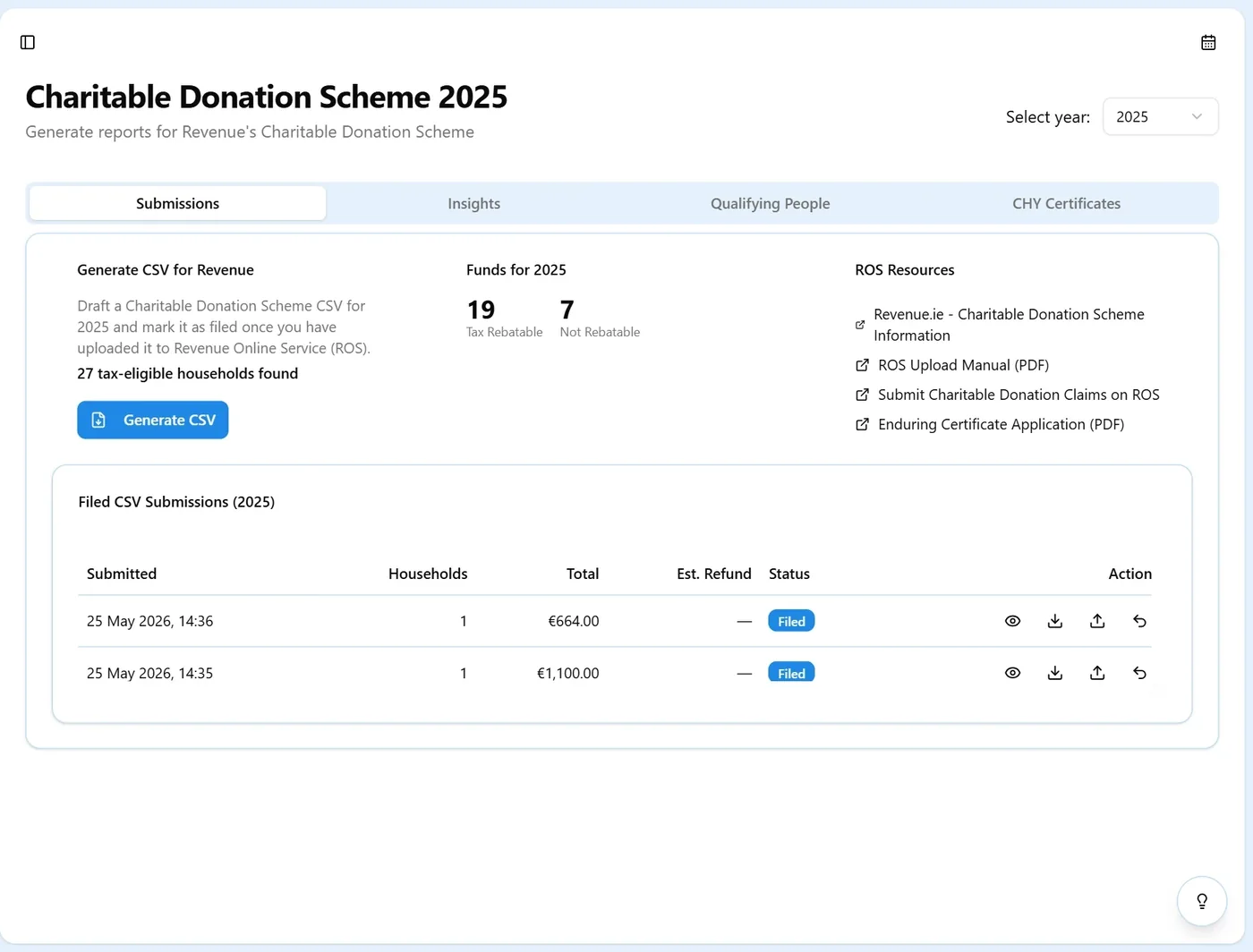
Emily Helps finds the households whose giving qualifies, sends each donor a CHY form to sign electronically, and produces the CSV that Revenue Online Service accepts. The refund the parish is entitled to stops depending on a stack of paper forms.

  • Qualifying donors identified automatically from the year's contributions
  • CHY3 and CHY4 forms sent by email for electronic signature
  • ROS-ready CSV, with each submission filed and tracked
Charitable Donation Scheme 2025 screen with Generate CSV for Revenue, counts of tax-rebatable funds, links to Revenue resources, and a table of filed CSV submissions
Sacraments

Baptisms, confirmations and marriages as guided cases.

Families request a baptism or a place in the confirmation class through a link the parish shares. The office reviews the request, books the date, tracks documents and certificates, and records the sacrament — with every step visible to whoever picks it up next.

  • Online request forms with a versioned privacy notice and recorded consent
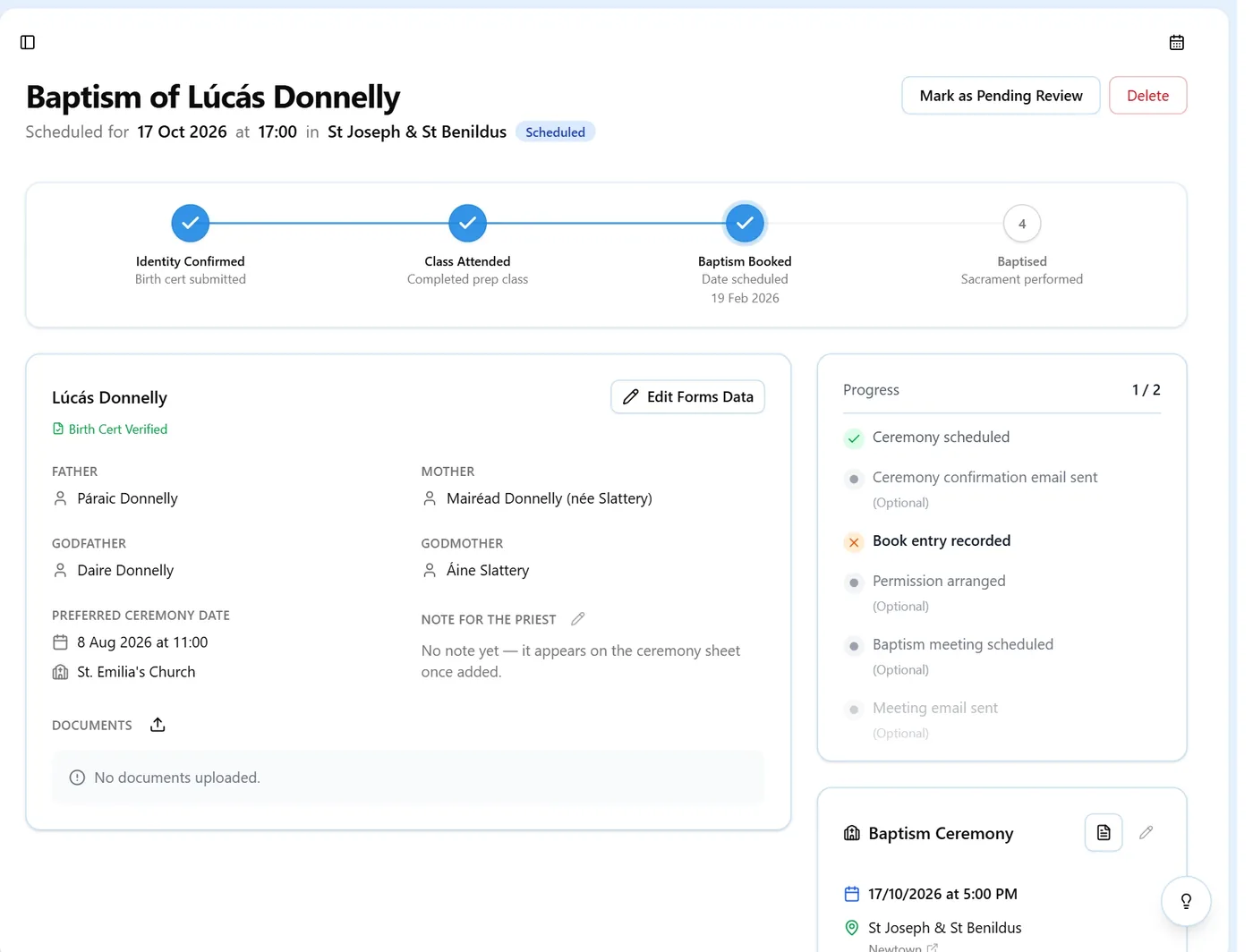
  • Step-by-step case view: identity confirmed, class attended, date booked, register entered
  • Communion and confirmation classes organised by school, with the bishop's events scheduled
  • Marriage cases with pre-nuptial enquiry, civil paperwork and fees tracked
A baptism case with a four-step progress bar — identity confirmed, class attended, baptism booked, baptised — plus child, parent and godparent details and a checklist of remaining tasks
The parish calendar

One schedule for everything that happens in the church.

Baptisms, weddings, confirmations, communions and meetings on a single timeline, filtered by church, by type or by status — so the sacristan, the priest and the office are all looking at the same page.

  • Week, month and year views across every church in the parish
  • Status at a glance: pending review, scheduled, approved, completed
  • Works on a phone at the church door as well as on the office PC
Sacrament schedule for the year with counters for all events, meetings, baptisms, confirmations, communions and marriages, and a timeline of upcoming events with statuses
For the diocese

Forty-five parishes, one set of answers.

A diocese that runs on Emily Helps can answer, on any given day, how many baptisms took place last year, which parishes have confirmation classes this spring, and what the Charitable Donation Scheme returned — without ringing forty-five parish offices. And it can staff those offices differently: one part-time secretary for a cluster of small parishes, instead of none.

Diocese-wide statistics

The numbers the bishop's office is asked for, already counted.

Parishes, parishioners, priests, schools, and this year's baptisms, confirmations and marriages — aggregated across the diocese, with the trend over time and the parish detail one click away for those with permission to see it.

  • Sacraments over time, diocese-wide and per parish
  • Religious, deacons, churches and school enrolment in one view
  • Diocesan roles see aggregates; parish data stays with the parish
Diocese Statistics screen: totals for parishes, parishioners, priests and schools, this year's baptisms, confirmations and marriages, religious and staff, and a chart of sacraments over time
Parishes, churches & clergy

One register for the structure of the diocese.

Every parish with its churches, clergy, schools and contact details in one place — as many parishes as the diocese has. Add a church, assign a priest, merge or cluster parishes as pastoral areas change, and keep the history of what was where, and when.

Because access is granted per parish, one part-time secretary can hold the Office Manager role for three or four small parishes at once. Parishes that could never justify a secretary of their own share one — and share the cost.

  • Parishes, personnel, organisations and schools for the whole diocese
  • Structure history: every change to a parish, church or appointment, dated and attributed
  • One secretary, several parishes: a single login with the Office Manager role across a cluster
  • Roles that match how a diocese works — Diocese Manager, Content Manager, Parish Priest, Parish Secretary
Parishes register for the diocese listing each parish with address, phone, email and website
The diocesan website

Published from the office, not maintained beside it.

Emily Helps generates the diocesan website — and a page for each parish — from the data parish secretaries already keep up to date. Mass times, clergy, churches and contact details are correct because they are the same record the office uses every day.

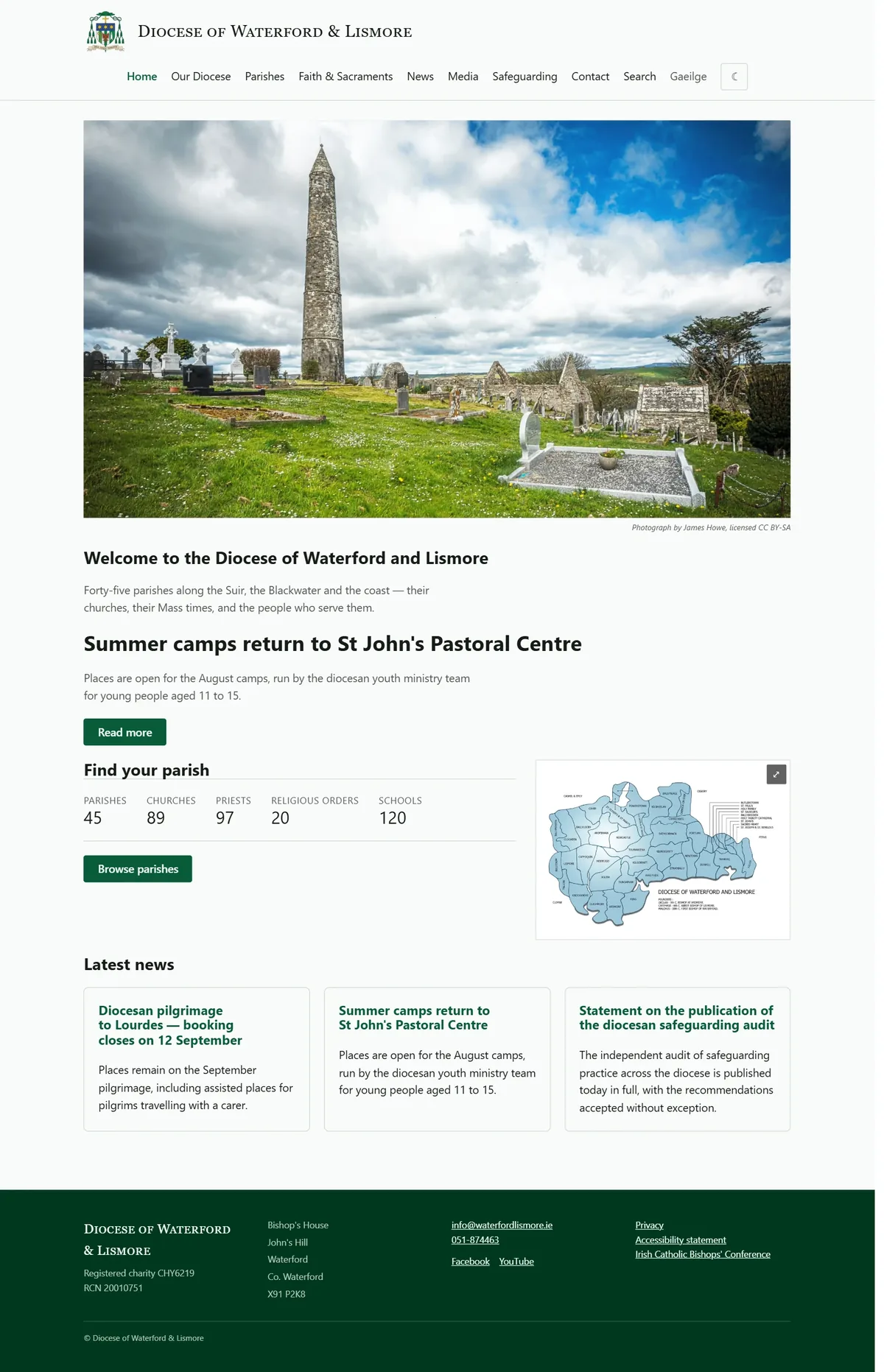
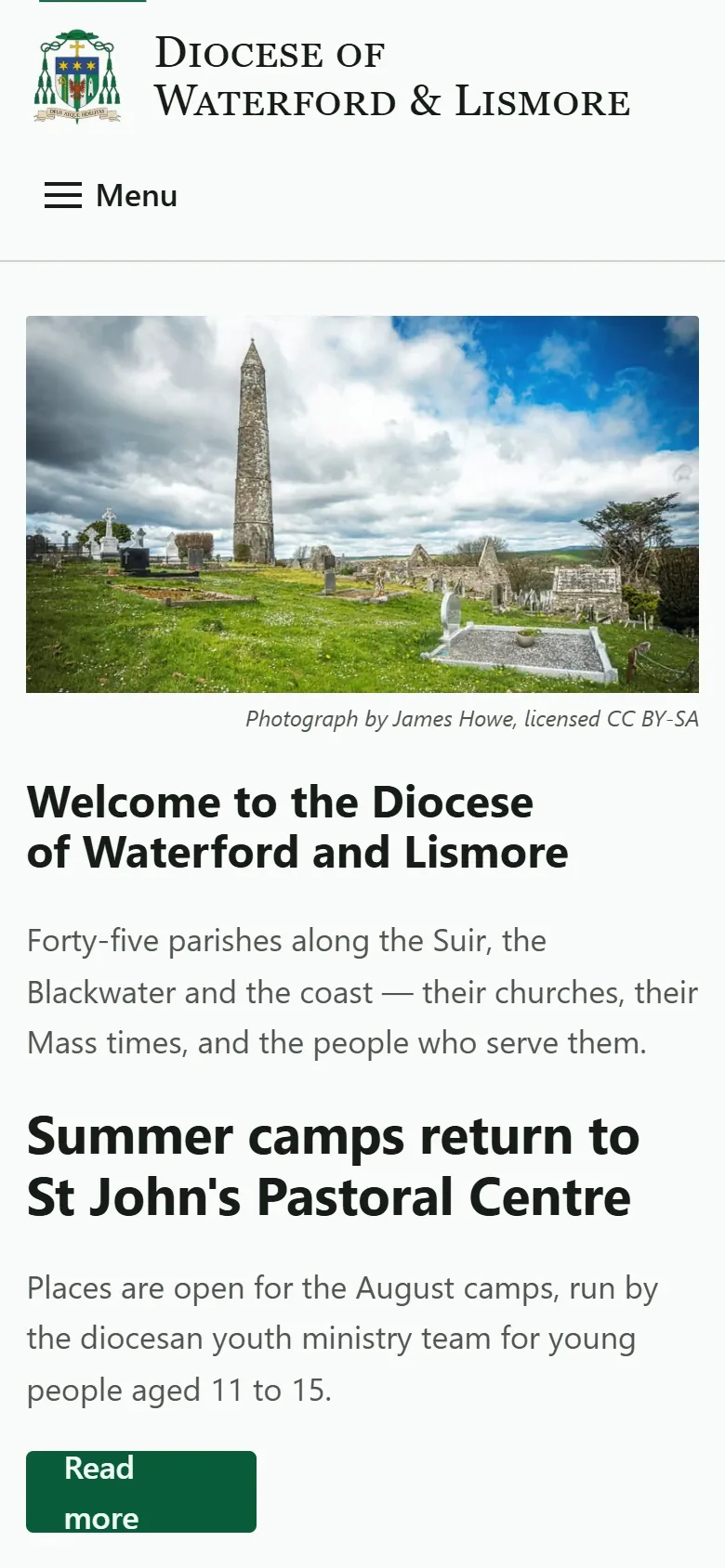
Shown here: the new site we are building with the Diocese of Waterford & Lismore — forty-five parish pages, Mass times for eighty-nine churches, news, safeguarding and an Irish-language version, all from one source.

Homepage of the Diocese of Waterford & Lismore website generated by Emily Helps: photograph of Ardmore round tower, welcome text, parish finder with counts and map, and latest news
Data protection & security

Built for the questions your DPO will ask.

Parish records are personal data of the most sensitive kind. Emily Helps was built for GDPR from the first line of code, and we have worked through a full Data Protection Impact Assessment with a diocesan Data Protection Officer.

Hosted in the EU

Your data is stored and processed within the European Union. Nothing is moved outside the EU for storage.

Encrypted in transit; encrypted backups

All traffic is encrypted. Off-site database backups are encrypted before they leave the server and are protected against deletion.

Access by role, per parish

Each user sees only the parish and functions their role allows. Diocesan roles see aggregates, not every parishioner.

Two-factor authentication

2FA on every account, including the shared-secretary and diocesan roles, and sign-in with Microsoft 365 or Google Workspace where the diocese already uses them.

A complete activity log

Every create, update and delete is recorded with who, when and from where — exportable for audit.

Consent recorded where it's given

Sacrament request forms carry a versioned privacy notice and record each consent given, so you can show what a family agreed to and when.

Retention that runs itself

Retention schedules remove personal data that is no longer needed, on a timetable the diocese sets with its DPO.

Data Processing Agreement

A DPA is part of every contract, with the processors and sub-processors we use listed plainly.

DPIA support

We supply the technical answers, data flows and register entries your DPO needs, and sit in the meeting if it helps.

Want the detail? We'll share our data-protection pack — data flows, processors, retention and the controls in place — before you commit to anything.

Request the pack
Rollout

From the old system to live, parish by parish.

A diocese doesn't switch overnight. We start with a handful of parishes, bring their data across, train the people who will use it every day, and grow from there.

  1. Scoping with the diocese

    What the diocese needs to see, which parishes go first, and what the website should carry. One meeting, one plan.

  2. Pilot parishes, data import

    We import from spreadsheets and from legacy parish systems, map the fields with the parish secretary, and check the numbers together.

  3. Training that fits the office

    Short, hands-on sessions — in the parish or online — for secretaries, priests and volunteers, with support on the phone afterwards.

  4. Diocese-wide rollout

    Remaining parishes are brought on in groups, the diocesan website goes live, and the diocesan team gets its statistics.

Questions

Frequently asked, honestly answered.

Where is our data held, and who can see it?
Within the EU, on infrastructure we operate. Access is by named user account with two-factor authentication, and each role sees only the parish and functions it needs. Our own staff access production data only for support, with your agreement, and that access is logged.
Does each parish keep its own data?
Yes. Every parish is a separate organisation within Emily Helps with its own users, households and registers. The diocese sees aggregated statistics and the shared registers it is entitled to; it does not browse a parish's parishioners.
Can one secretary look after several small parishes?
Yes. Access is granted per parish, so a part-time secretary can be given the Office Manager role for a cluster of parishes and move between them with a single login. Parishes that could never fund a secretary of their own share one, and the cost with it — each parish's records stay its own.
We're moving from B&L, or from spreadsheets. How does migration work?
We import households, envelopes, contributions and sacramental records from exports of your current system, map the fields with the parish secretary, and reconcile the totals before you go live. Your historical records come with you.
How does the Charitable Donation Scheme work in Emily Helps?
Emily Helps identifies donors who qualify from the year's contributions, emails each of them a CHY3 or CHY4 form to sign electronically, tracks who has signed, and produces the CSV file that Revenue Online Service accepts. Each submission is filed against the year.
How do families request a baptism or a confirmation place?
The parish shares a link — on its website, in the newsletter or by email. The family completes a form that carries the parish's privacy notice and records their consents; the request lands in the office to review, book and follow up.
Does it work on phones and tablets?
Yes. Emily Helps is a web application; there is nothing to install and it works in any modern browser on a PC, tablet or phone. Priests and sacristans use it at the church door as often as the office uses it at a desk.
What does it cost?
Emily Helps is priced per diocese, based on the number of parishes, and includes hosting, support, updates and the diocesan website. Request a demo and we will send a proposal for your diocese.
Who is behind Emily Helps?
Emily Helps is designed and built in Ireland by AMDG Technologies Ireland Limited. It was built in working partnership with parish secretaries and diocesan staff, and it is developed with them still.
What if a parish needs help on a Friday afternoon?
You email or ring us. Support is part of the service, given by people who know what a parish office looks like the week before Confirmation.
Can we see it with our own data before deciding?
Yes. After a first demo we can set up a pilot parish with an import of its real data so the secretary can judge it on the work she actually does.
Request a demo

See it running, with parish data that looks like yours.

Forty-five minutes, online or in the diocesan office. Bring your DPO, your finance manager and a parish secretary — they will each have different questions and we would rather answer them together.

  • A walk-through of the parish office and the diocesan view
  • The Charitable Donation Scheme and sacrament workflows in detail
  • Our data-protection pack and a draft rollout plan for your diocese

Prefer to talk? Ring Richard on +353 85 740 2298, or email [email protected] and we'll come back to you within two working days.

We use these details only to arrange your demo. How we handle them.